Blog
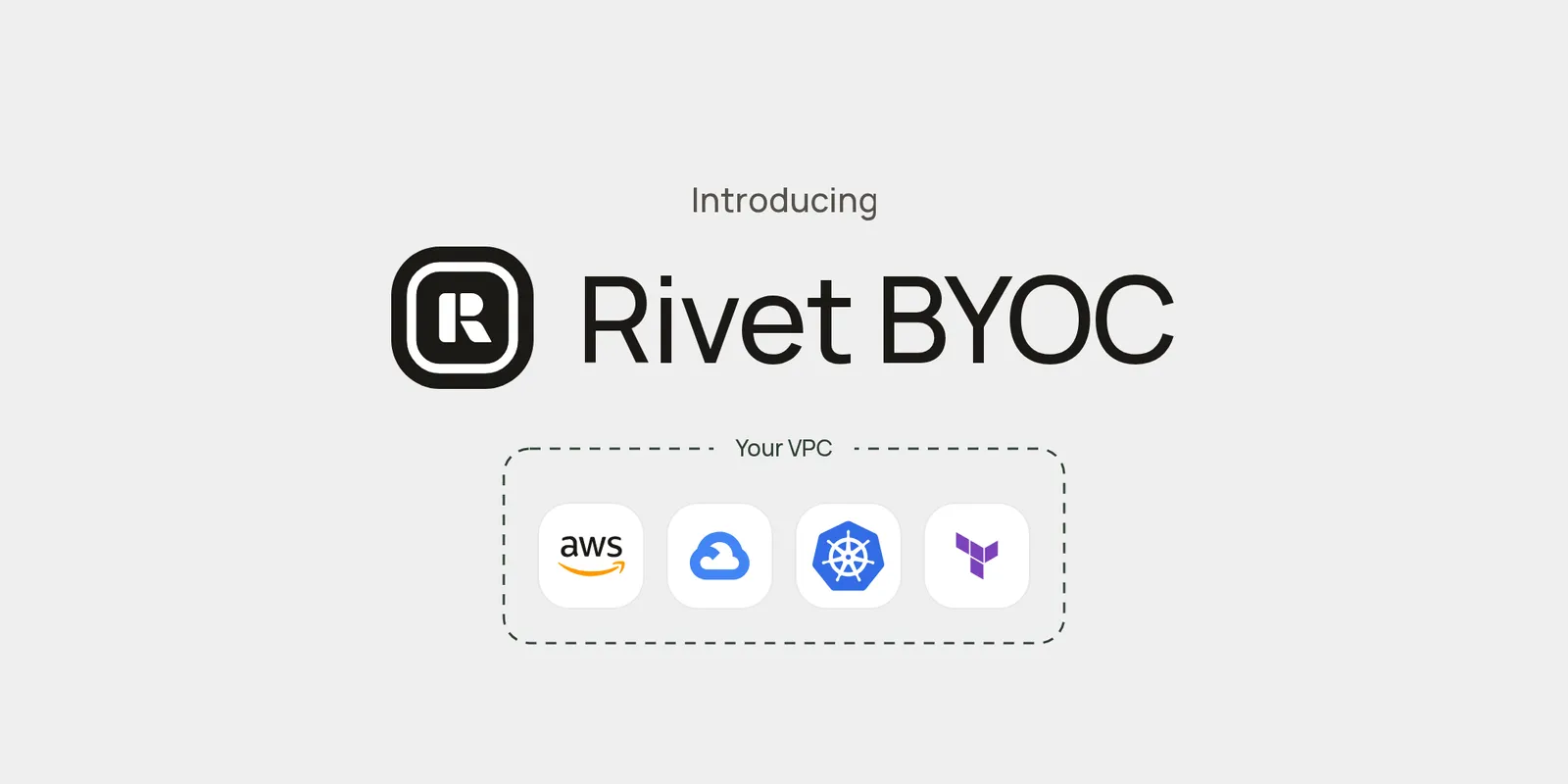
Introducing Rivet BYOC
Run the Rivet control plane inside your own AWS or Google Cloud VPC, fully managed by Rivet. Your data stays in your account and Rivet Cloud never needs inbound access.
Today we’re releasing Rivet BYOC (Bring Your Own Cloud): the Rivet control plane deployed inside your own AWS or Google Cloud VPC, managed by Rivet. Your data and compute never leave your security perimeter, and the only connection to Rivet Cloud is outbound.
What you get
- Your account, your data: the control plane, FoundationDB, and your actors run in your VPC
- Outbound only: no inbound rules from Rivet Cloud. Your admin token stays in your cloud secret manager.
- Managed by Rivet: deployment, updates, and maintenance are handled for you
- Public or private: expose Rivet over HTTPS on your own hostname, or keep it on your private network
- Dashboard included: manage your actors from the Rivet dashboard, tunneled to your deployment
Deploy from the dashboard
- Open the Rivet dashboard, click Create Project, and select BYOC
- Download the setup kit and cluster config from your project’s BYOC page
- Set your account, regions, and hostname in
terraform.tfvars.json, then runterraform apply
Full steps are in the quickstart.
How it works
A Rivet operator runs in your Kubernetes cluster. It pulls commands from Rivet Cloud, applies updates to the control plane inside your cluster, and reports status back. Rivet Cloud never connects in.
Multi-region
- Each region gets its own VPC, cluster, operator, and control plane
- Data stays in the region that produced it. Pin EU users to an EU region for GDPR, or keep regulated workloads in-country.
- Regions talk over private connectivity and share a container registry
- Workers connect to their regional endpoint
Availability
- Available today on AWS and Google Cloud with Rivet Enterprise Edition
- Free 14-day trial: create a BYOC project in the Rivet dashboard and follow the quickstart. The deployment shuts down automatically when the trial ends.
- Air-gapped deployment? Talk to an engineer