Run coding agents in sandboxes.
Control them over HTTP.
A server runs inside your sandbox. Your app connects remotely to control agents, stream events, handle permissions, and manage sessions.
- Claude Code
- Codex
- OpenCode
- Cursor
- Amp
- Pi
One integration. Your choice of agent.
Every agent has different APIs, event formats, and permission flows. Sandbox Agent handles those differences so your application can use one interface.
One API for every agent
Start sessions, send prompts, handle permissions, and stream events through a single interface. Swap agents without rewriting your integration.
Streaming events
Receive events as the agent works. Store the conversation in your own database for replay, auditing, and session restoration.
Your choice of sandbox
A lightweight Rust server runs inside your sandbox. Connect from your application over HTTP, or use the TypeScript SDK locally.
Files, processes, and terminals
Read and write files, run commands, and attach to terminals alongside your coding agent.
Skills and MCP
Configure skills, MCP servers, and custom tools for your agents through the same SDK.
OpenCode compatibility
Use OpenCode tooling to control supported agents through the experimental compatibility API.
Deploy on E2B, Daytona, Vercel, Cloudflare, Docker, Modal, or your own infrastructure.
Get started
Install the TypeScript SDK, start a server, and send your first prompt.
npm install sandbox-agent@0.4.xInspect every session
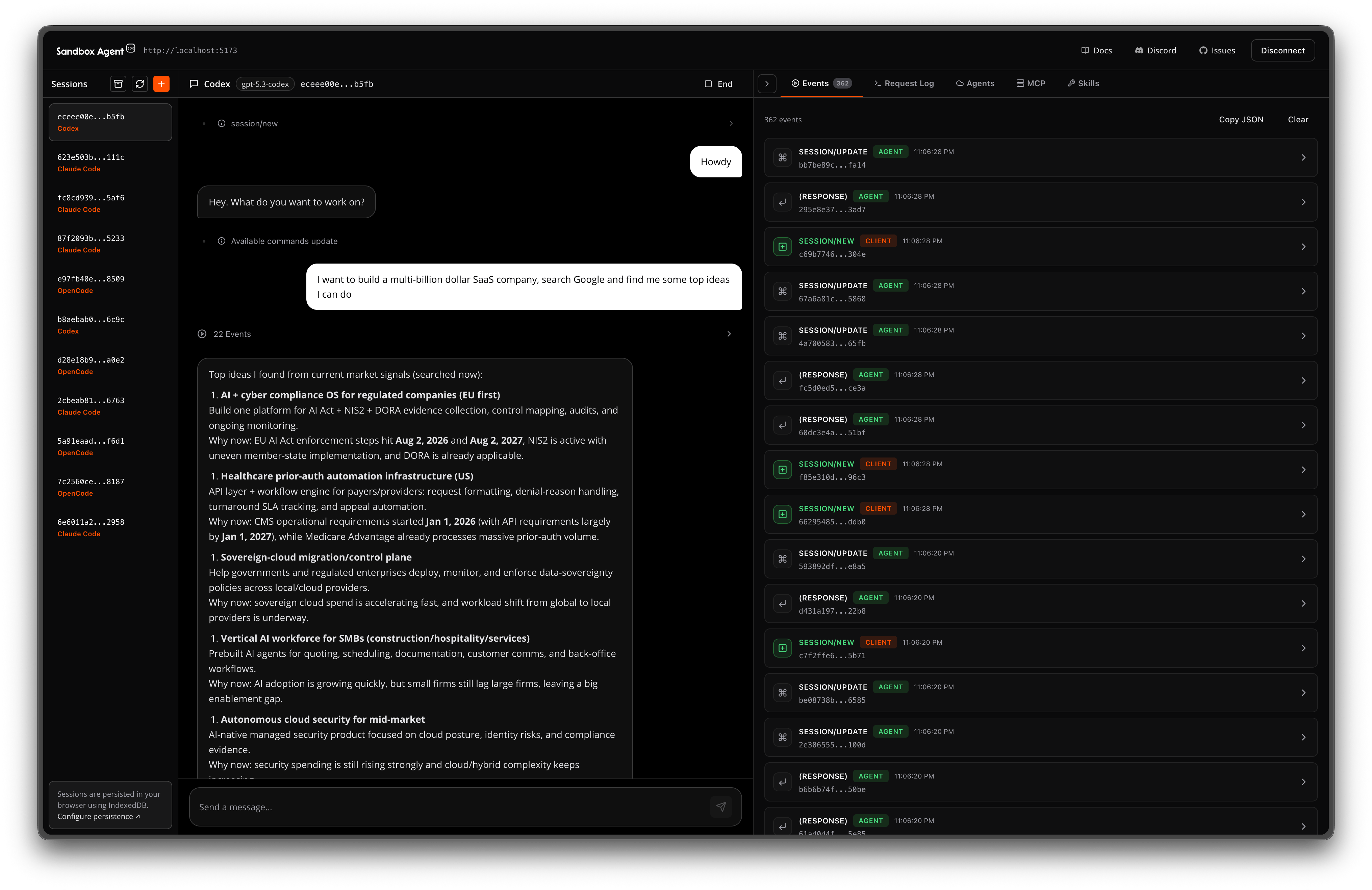
Use the built-in Inspector to view conversations, examine event payloads, and troubleshoot your integration.
Questions and answers
Does this replace the Vercel AI SDK?
They work together. AI SDK helps you build chat interfaces and call language models. Sandbox Agent controls coding agents that write code and run commands.
Which coding agents are supported?
Claude Code, Codex, OpenCode, Cursor, Amp, and Pi. The SDK normalizes their APIs so you can swap agents without changing your integration.
How is session data persisted?
Session events use a shared schema that you can store in your own database. The persistence guides cover IndexedDB, SQLite, Postgres, and Rivet.
Can I run this locally?
Yes. Run locally for development or deploy the server inside a sandbox. The same SDK supports both.
Does it support my platform?
The server is a Rust binary that runs in Docker, virtual machines, and sandbox providers. The docs include deployment guides for E2B, Daytona, Vercel, Cloudflare, Modal, and more.
Can I use my own API keys?
Yes. Supply your own provider credentials, or use sandbox-agent credentials extract-env to extract credentials from your local agent configuration.
Why Rust?
Rust provides a single binary, fast startup, and predictable memory usage, so the server can run inside sandboxes and CI without a separate application runtime.
Why use a sandbox?
Coding agents run commands and change files. A sandbox isolates those operations from your application servers. Sandbox Agent supplies the API for controlling the agent remotely.
How is this different from an agent’s official SDK?
Official SDKs typically run local processes. Sandbox Agent runs a server inside the sandbox so your application can control those processes over HTTP.
Why not SSH?
Coding agents need streaming output, interactive terminals, and permission handling. Sandbox Agent exposes these capabilities through an application API.