Introducing the agentOS Package Registry
We built the package registry for agentOS. npm install the infrastructure your agent needs.

agentOS is a lightweight alternative to sandboxes that doesn’t require a heavyweight VM. We built it to be the best way to ship agents: performant, efficient, flexible, and dead simple to use.
Today we’re doubling down on the last two. The agentOS Package Registry makes agents flexible and simple: npm install any capability your agent needs, from binaries to browsers to sandboxes.
Why a new registry?
Every agent is different, and there’s no one-size-fits-all:
- A simple support agent might only need a browser and an HTTP client.
- A background agent churning through a queue needs cron and durable state.
- A coding agent needs a full filesystem, a shell, a compiler toolchain, and a sandbox to run untrusted code.
Each is a different set of tools on top of the same runtime.
On top of that, agentOS runs Linux on WebAssembly, so every command has to be cross-compiled to WebAssembly. Existing registries like apt and Homebrew ship native binaries, not WebAssembly, so none of them work here. agentOS needs a registry purpose-built for it.
The agentOS Package Registry is how both official Rivet packages and community packages are shared. It lets you pick and choose the tools your agent needs and add them with a simple npm install.
1,900× faster than apk, 6,700× faster than apt
Traditional package managers like apt and Homebrew copy and unpack files on every install, taking seconds due to expensive filesystem operations.
Instead, agentOS packages install in 130µs. That’s 1,900× faster than apk and 6,700× faster than apt.
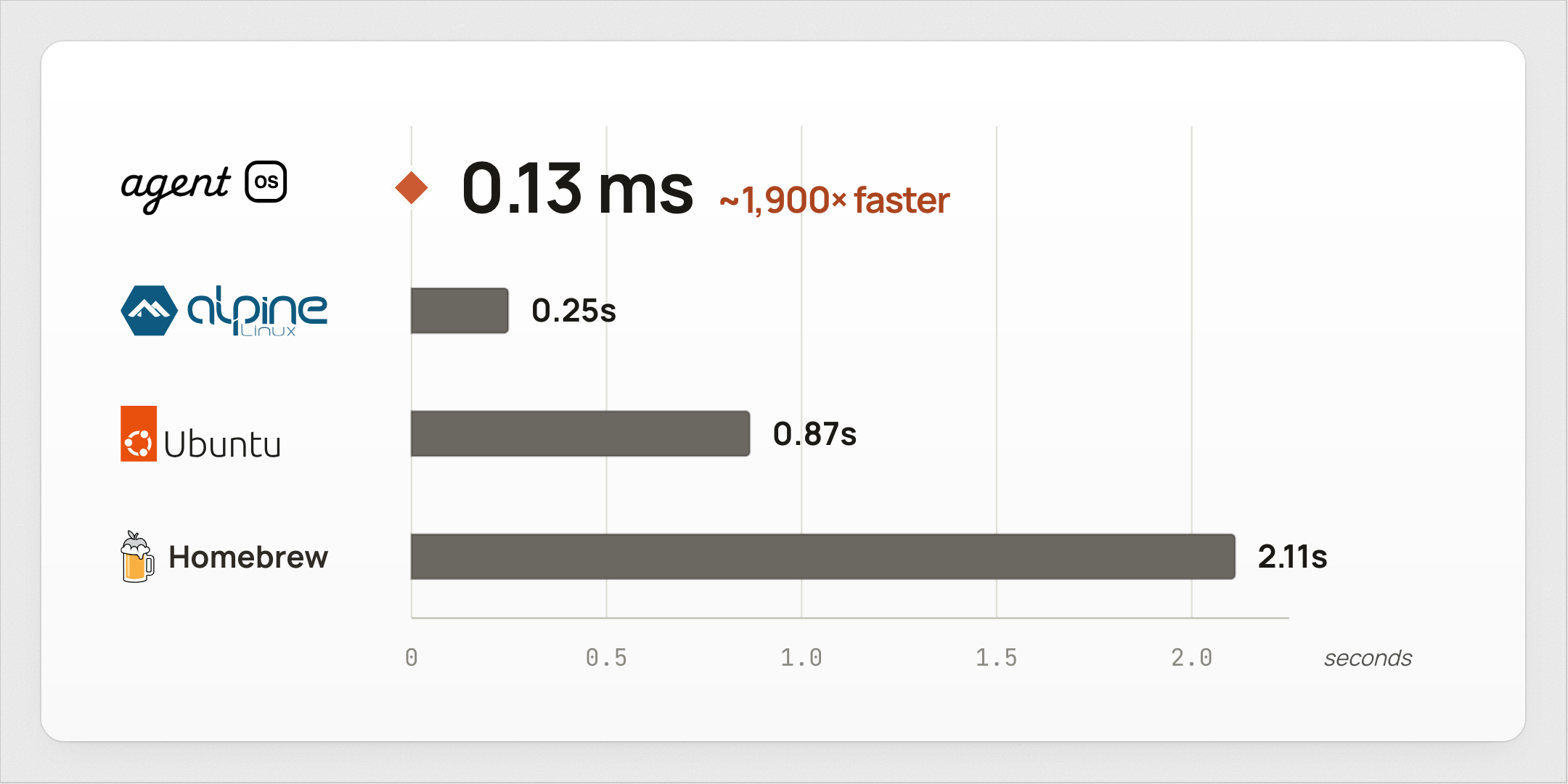
agentOS mounts the package straight into the VM’s filesystem, with zero I/O. Adding packages never touches your cold start, so your agents stay fast no matter how much you install.
For the full breakdown of how this works, read Building the World’s Fastest Package Manager with agentOS.
What the registry provides
The registry is your one-stop shop for everything you need to provide to an agent:
- Binary commands: CLI tools cross-compiled to WebAssembly and installed into the VM, like
ripgreporjq, akin to apt installs. - Agents: coding agents like Pi, Claude Code, Codex, and OpenCode, all behind one unified interface.
- File systems: mount S3, GitHub, or a database as the agent’s file system.
- Browsers: headless browsers for navigating, scraping, and automating the web.
- Sandboxes: full sandboxes mounted on demand for heavy workloads like desktop automation and native compilation.
- Bindings: your own host functions exposed to the agent as CLI commands inside the VM.
Backed by npm
npm has withstood the test of time with broad compatibility, so it was an obvious choice for delivering agentOS software.
It’s tempting to think shipping your own package registry is easy: an S3 bucket and an index and you’re done. But that skips everything a real registry needs:
- Dependencies & semver: packages compose and version against each other with battle-tested resolution.
- Release tracks: publish stable, beta, and canary channels side by side.
- Team management: scoped orgs with per-package publish permissions.
- Security: npm’s audit tooling and advisory database, inherited for free.
- Self-hosting: run a private registry inside your own network.
The agentOS Package Registry ships with all of this out of the box by leveraging npm’s infrastructure.
Enterprise-ready
Because it’s built on npm, agentOS is enterprise-ready from day one:
- Self-hosted registries
- Team-based publishing
- npm’s security tooling
Build your own packages
The agentOS package format makes it easy to ship your own package for custom agents, binaries, sandboxes, and more.
All it takes is:
- Point your coding agent at the package definition docs
- Publish to npm
- Share your npm package with everyone
Pull requests are welcome to get your package listed in our registry.